08 — The Port
Input and feel
The same game on a different controller is a different game.
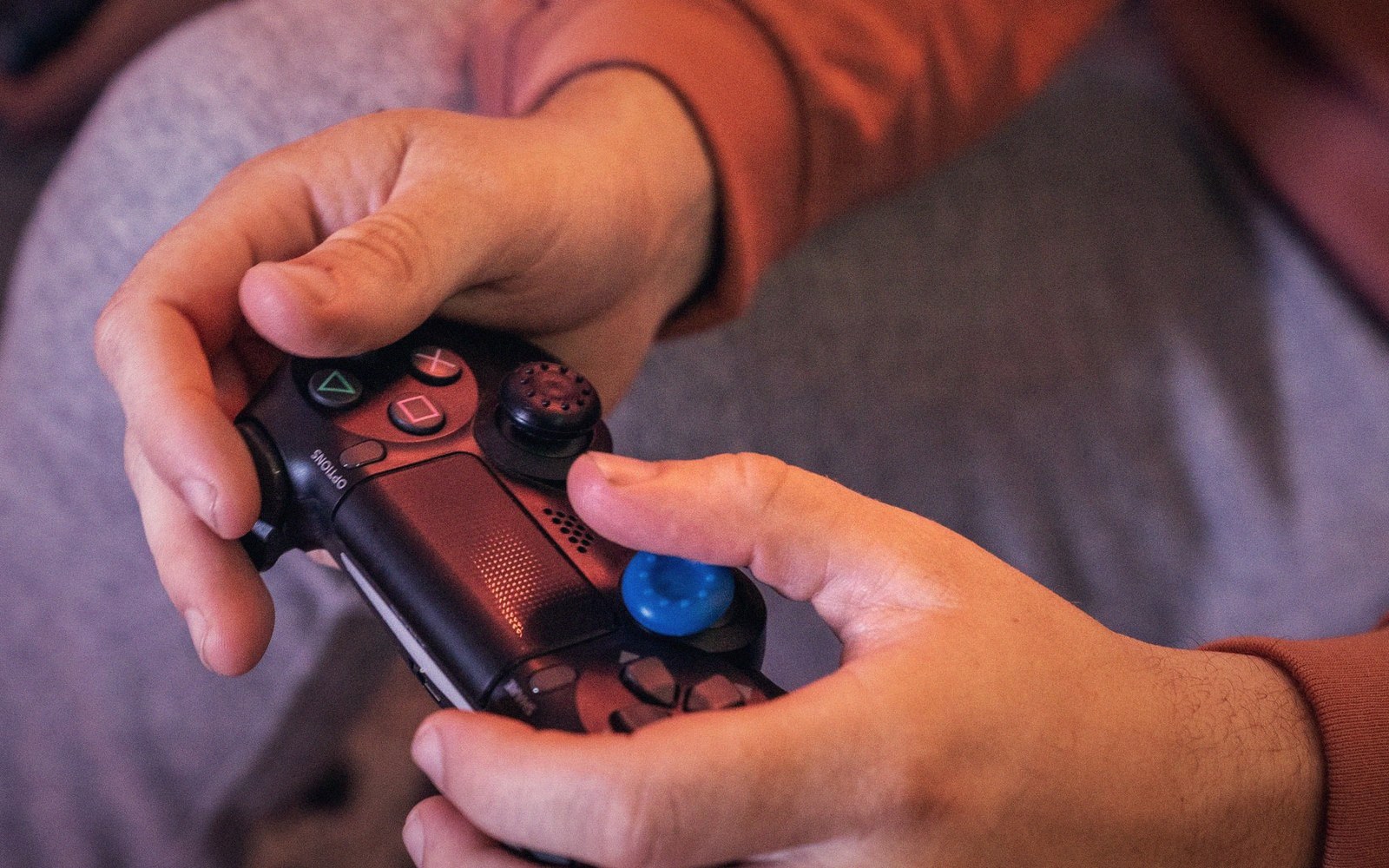
Hands on the controller: what the budget bought, judged by feel rather than by figures.
Photo: Kevin Malik / Pexels
A different controller is a different game
Porting a game is rarely just compilation and submission. The rendering differences get the attention — resolution, frame rate, platform certification — but the change players feel first is in their hands. A game tuned for a dual-analogue controller over two years of iteration does not automatically feel right on a handheld with smaller sticks, stiffer triggers, or no triggers at all.
The problem runs deeper than button remapping. Analogue stick dead zones, trigger sensitivity curves, rumble motor strengths, and gyroscope behaviour are all hardware-specific. A dead zone tuned on one first-party controller will feel either sluggish or twitchy on another platform's equivalent, because the physical range of motion and the precision of the sensors differ. The input stack that ships in the original game bakes in assumptions about the hardware — not always consciously, but always consequentially.
Haptic feedback is its own discipline now. The difference between rumble as a binary on/off and a full-range haptic actuator is not cosmetic; it carries information. A game that communicates terrain, weapon weight, or hit confirmation through haptic texture loses a layer of meaning on hardware that cannot reproduce it. The port either rebuilds that communication in another channel — audio cue, visual flash — or ships with a quiet hole where the feeling used to be.
Keyboard and mouse adds a different axis of complexity. Analogue movement mapped to digital keys requires a new feel entirely: acceleration curves replace stick curves, and aiming games built around controller auto-assist need a separate tuning pass for mouse input, where precision is higher but physical momentum is absent. Treating mouse support as a checkbox rather than a discipline is one of the more reliable ways to earn bad word of mouth from a port.
Test hardware is where a port stops being a theory.
Photo: Sergei Starostin / Pexels
Latency compounds all of it. Display latency, audio latency, and input latency stack together, and a port that adds even two or three frames of input lag to a platformer or a fighting game will feel worse in a way players can sense immediately without being able to name. The profiling work done for rendering needs an equivalent pass for input: measure the round trip from button press to on-screen response, on every target platform, before declaring the port done.
The honest answer is that input feel is an iteration-time problem: it takes hours of play, not hours of code, to find the right curves. Studios that schedule a dedicated tuning period for each platform's controller produce ports that feel like ports in the best sense — the same game, re-fitted. Studios that treat it as configuration rather than craft produce something recognisable but slightly wrong, and players, who spend their lives holding controllers, will know immediately.
The input stack that ships in the original game bakes in assumptions about the hardware — not always consciously, but always consequentially.
A debug overlay is the only honest view of a frame — costs, counts, and what the renderer quietly decided not to draw.
Photo: lalesh aldarwish / Pexels