03 — Grey Box
Level plans
Drawn on paper first, because moving a wall is free there.

Marked in pen, because moving a wall on paper is free and moving it in the engine is not.
Photo: Monstera Production / Pexels
The cheapest form of iteration is paper
A level plan starts life as a sketch — a rough overhead view that fits on a single sheet. Before a designer opens an engine, before a single piece of geometry gets placed, the shape of a level exists as pencil lines and annotations: a choke point marked with an arrow, a sight-line crossed out and redrawn, a room that keeps shrinking on every revision because nobody can justify its square footage.
The point is that moving a wall costs nothing there. In an engine, every reposition touches navmesh, lighting data, collision, streaming boundaries, and the sanity of whoever built the geometry. On paper, it costs one stroke of an eraser.
What a plan captures at this stage is not art direction or atmosphere — it is routing. Where does a player enter, and how many ways can they leave? Where does a designer want tension, and where does she want relief? A good sketch makes the loop legible: the critical path drawn solid, the optional paths drawn dashed, and any dead ends circled for question. If the logic of the space cannot be read from the overhead, the level has a structural problem that no amount of dressing will fix.
Plans graduate from paper to something more formal before blockout begins: usually a clean overhead in an image editor, with rough dimensions noted, spawn points and scripted events marked, and a short written brief attached. This document serves the level designer, yes, but also the systems designer checking encounter budgets, the environment artist estimating modular kit requirements, and the producer tracking scope. One sketch talks to everyone.

A blockout on three monitors. At this stage the shape of the level is the only thing under discussion.
Photo: cottonbro studio / Pexels
Scale is the first thing a paper plan gets wrong. Rooms that read well at thumbnail size routinely feel cavernous when a character is walking through them at one metre eighty. Experienced designers build a reference bar into their sketch — a line representing a player capsule's movement speed across ten seconds, which grounds the drawing in actual traversal time rather than drafting instinct. The first blockout pass exists partly to test whether the plan's spatial hunches were sound, and some walls will move then regardless. The goal is to have moved the obviously wrong ones earlier, for free.
Revision history matters. A plan that has been through several iterations before geometry is touched carries its reasoning in the crossed-out lines and margin notes. When a producer asks why the level has no shortcut, or a director asks why the pacing slows in the second half, the plan shows the decision — and who made it. That trail has no monetary cost and saves considerable argument later.
In an engine, every reposition touches navmesh, lighting data, collision, streaming boundaries, and the sanity of whoever built the geometry.
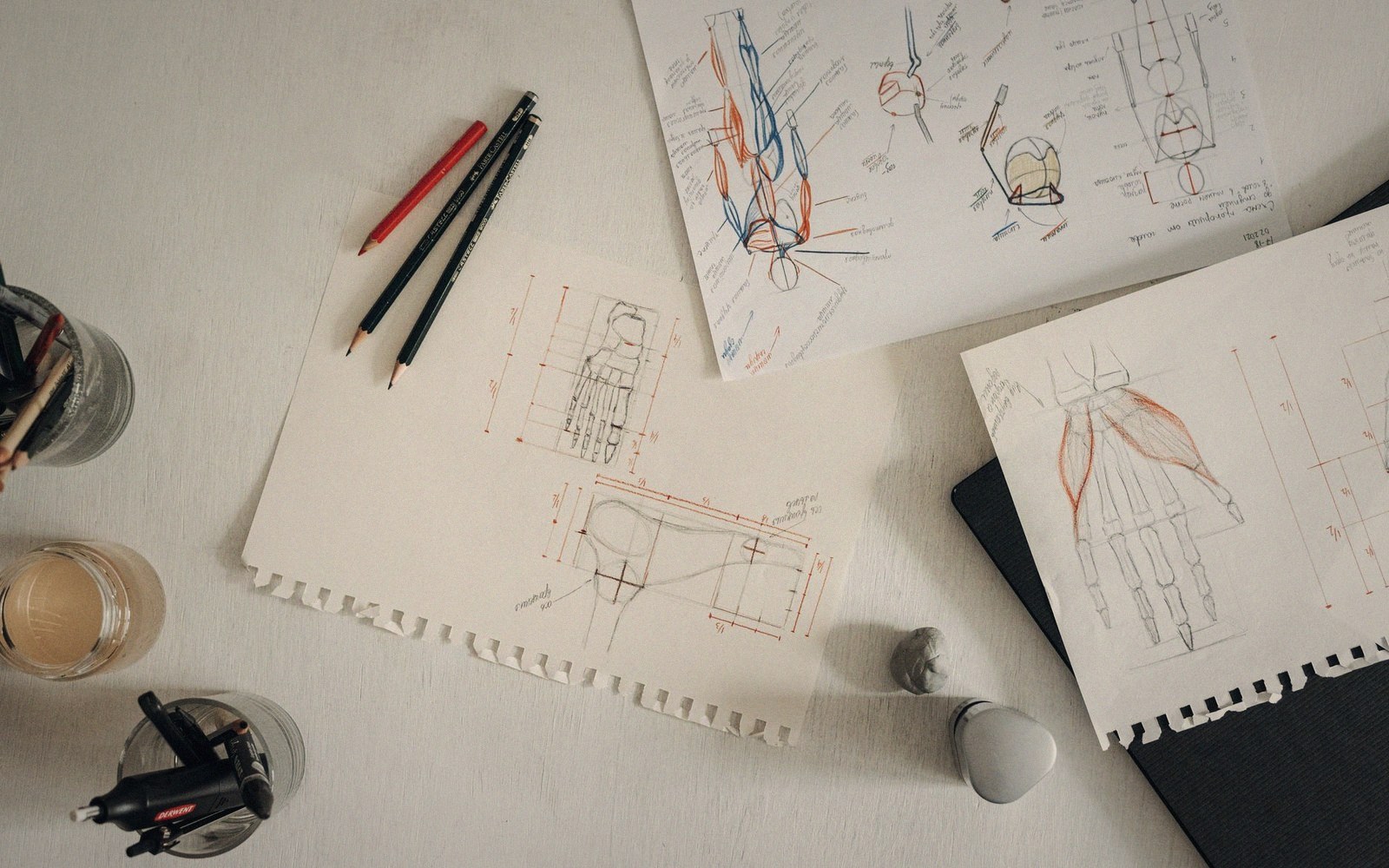
What a level looks like before it exists: routes, sightlines and one crossed-out room.
Photo: Anete Lusina / Pexels