05 — The Milestone
What a build is for
A milestone build is a communication device aimed at somebody outside the team, which is why it distorts priorities.

A build shown to somebody outside the team, which is exactly what distorts it.
Photo: Mikael Blomkvist / Pexels
A milestone build is a communication device aimed at somebody outside the team, which is why it distorts priorities.
Every project has builds — hundreds of them, produced automatically or by hand, used internally to catch regressions and test new work. A milestone build is something different. It is a snapshot prepared for a specific audience: a publisher, a platform holder, a board, an investor. The audience changes what goes into it, and that change has consequences that outlast the meeting.
The gap between showing and shipping
Internal builds are honest in the way only private things can be. Placeholder art sits next to finished systems; broken features are commented out and noted; frame rate dips are known, logged, and tolerated because the team is not done yet. The milestone build tidies all of this away. Temporary fixes get applied. The best-looking section gets polished beyond its turn. A feature that does not work in the full game gets excised from the build path so reviewers never reach it. None of this is dishonest exactly — you are showing what exists at its best — but the result is a build that does not represent the project's real state.
The distortion runs in both directions. Whatever the team polished for the milestone is now ahead of the surrounding work. Whatever was hidden is now further behind, and the debt has not been acknowledged in any schedule. After the meeting, work resumes from the actual codebase, which is messier and less stable than what was demonstrated, and there is often a quiet reckoning as the temporary fixes are either absorbed properly or quietly left in place, which is worse.
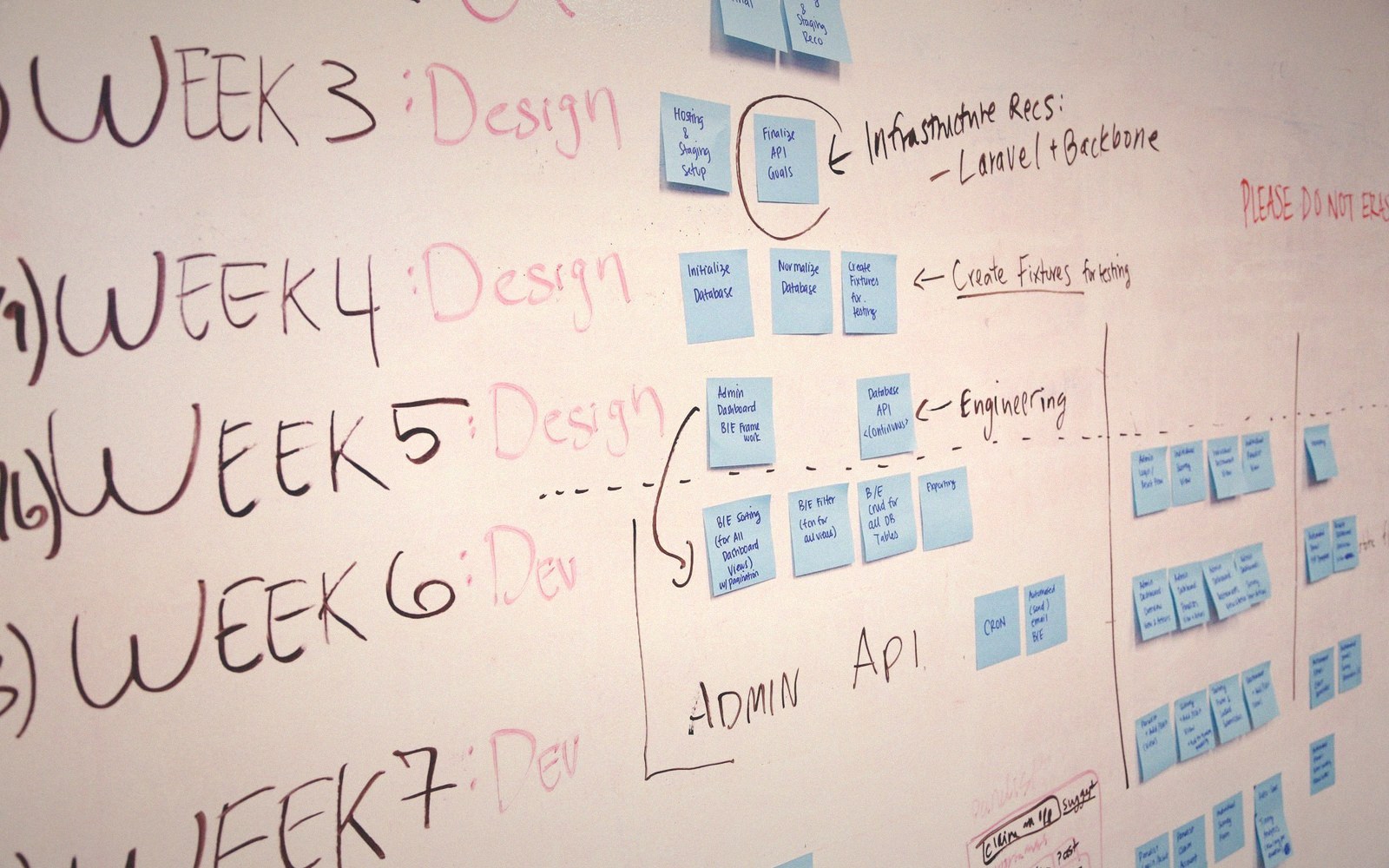
A schedule half rubbed out. What survives a cut is whatever something else already depends on.
Photo: Startup Stock Photos / Pexels
Who the audience is, and what they need
A publisher representative reviewing a milestone build is not asking the same question the development team is. The team is asking whether the systems hold together, whether the blockout geometry is reading correctly, whether the asset pipeline is processing cleanly. The publisher is asking whether this looks like the product they agreed to fund, and whether the schedule they signed off on is plausible given what they can see. These are legitimate questions, but they pull toward completeness of appearance rather than soundness of foundation.
Platform holders add a further layer. Certification submissions are milestone builds of a particular flavour — they must pass a checklist that is entirely indifferent to how the game feels to play or how maintainable its codebase is. The team learns to build toward the checklist, which is a rational response to a real constraint, and a further drift from the build that represents actual progress.
None of this is dishonest exactly — you are showing what exists at its best — but the result is a build that does not represent the project's real state.
The problem compounds when milestone dates are fixed too early in production. A build prepared under genuine time pressure will favour whatever is most visible. Gameplay systems that run invisibly — save-state integrity, input handling, memory behaviour on the minimum-spec machine — fall behind the things a reviewer in a meeting can see on a monitor. The visible debt gets paid down on a schedule; the invisible debt accumulates until the last ten per cent, when it is suddenly the only thing anyone is talking about.

A blockout on three monitors. At this stage the shape of the level is the only thing under discussion.
Photo: cottonbro studio / Pexels
Keeping the build honest
The teams that navigate milestone pressure best tend to separate the communication layer from the development build explicitly. The milestone build is prepared from a branch; the main line keeps moving; the fixes applied for the show are either ported back or documented as known divergences. This costs a little time and discipline, and it is almost always worth it. It means the team's internal picture of the project does not warp to match the external presentation.
It also means that when something is not ready to show, the team has the language to say so without implying the project is in trouble. A build is honest about what it represents when the people who made it know the difference between showing well and being well — and can explain that difference to the room.
| Line item | What it means in the build |
|---|---|
| Post-milestone reckoning | temporary fixes applied for a show must be absorbed properly or left as silent technical debt |
| Early-fixed milestone dates | lock dates before systems exist forces polish of surface over foundation |
| Certification as milestone variant | platform-holder checklists pull build priorities toward compliance, not toward play quality |
The patterns in this entry are general observations, not a measurement of any particular production.