05 — The Milestone
The Vertical Slice
A small piece finished to shipping quality — enormously useful and reliably misleading about the rest.

One stretch of the game at full quality, which says less about the rest than it appears to.
Photo: Yan Krukau / Pexels
A small piece finished to shipping quality — enormously useful and reliably misleading about the rest.
What it is and why you make one
A vertical slice is a single, self-contained section of a game — typically one level, one encounter, or one loop of gameplay — built to the standard the finished product is meant to reach. Everything is in: final art, mixed audio, tuned mechanics, the UI that belongs to it. Where the rest of the project is placeholder and grey, this piece is done.
The name comes from the way it cuts through every layer of the stack at once. Most early production moves horizontally — broad, shallow, many systems roughed in. The slice moves vertically, assembling one column of the thing at full depth: design, code, audio, art, animation, lighting, all the way from concept to the player-facing surface. A team that builds one discovers, often for the first time, what it actually costs to finish something.
That discovery is the point. Studios make vertical slices for two audiences: internal leadership, who need to know whether the approach is achievable, and external partners — publishers, investors, platform holders — who need to see the game as a product, not a promise. The slice is a communication device carrying a specific argument: this is what a finished piece looks like, and we can make more of them.

A blockout on three monitors. At this stage the shape of the level is the only thing under discussion.
Photo: cottonbro studio / Pexels
What it teaches, and where it lies
The honest value of a vertical slice is what it teaches the team. Finishing anything to real quality exposes gaps that no design document reaches: the animation that needs two extra states to feel right, the shader that runs fine in isolation and tanks frame time in a dressed level, the puzzle whose solution seemed obvious in paper form and baffled every playtester. A team that has built one slice carries that knowledge into the rest of production. A team that has not is still learning from first principles when the schedule is already tight.
The slice also stress-tests the asset pipeline. Importing, processing, and integrating final-quality assets at scale surfaces bottlenecks that only appear under real material: naming conventions that break, texture memory that overruns, lighting builds that take hours. Discovering those problems on one level — where they are containable — is orders of magnitude cheaper than discovering them across thirty.
A team that builds one discovers, often for the first time, what it actually costs to finish something.
Here is where it becomes misleading. A vertical slice is built by the whole team, or the best of it, focused entirely on one section. Every problem that arises is solved immediately. Every piece of ambiguity in the design is resolved by whoever is in the room. The result looks achievable because the conditions that produced it were exceptional, and those conditions do not persist through full production. When a studio later asks why levels three through twelve are running behind, the honest answer is often that level one was finished with an intensity and a concentration of talent that was never going to scale. The slice proves the game can exist; it does not prove the team can make forty more of it in the remaining months.
This is a structural problem, not a failure of individual skill or effort. Building a slice compresses decisions that will later be distributed across many people working in parallel, with incomplete information, on overlapping systems. The slice benefits from coherence that production, by its nature, dissolves. Studios that treat the slice as a throughput estimate — it took us four weeks, so we can ship ten levels in forty weeks — are usually wrong, sometimes badly.
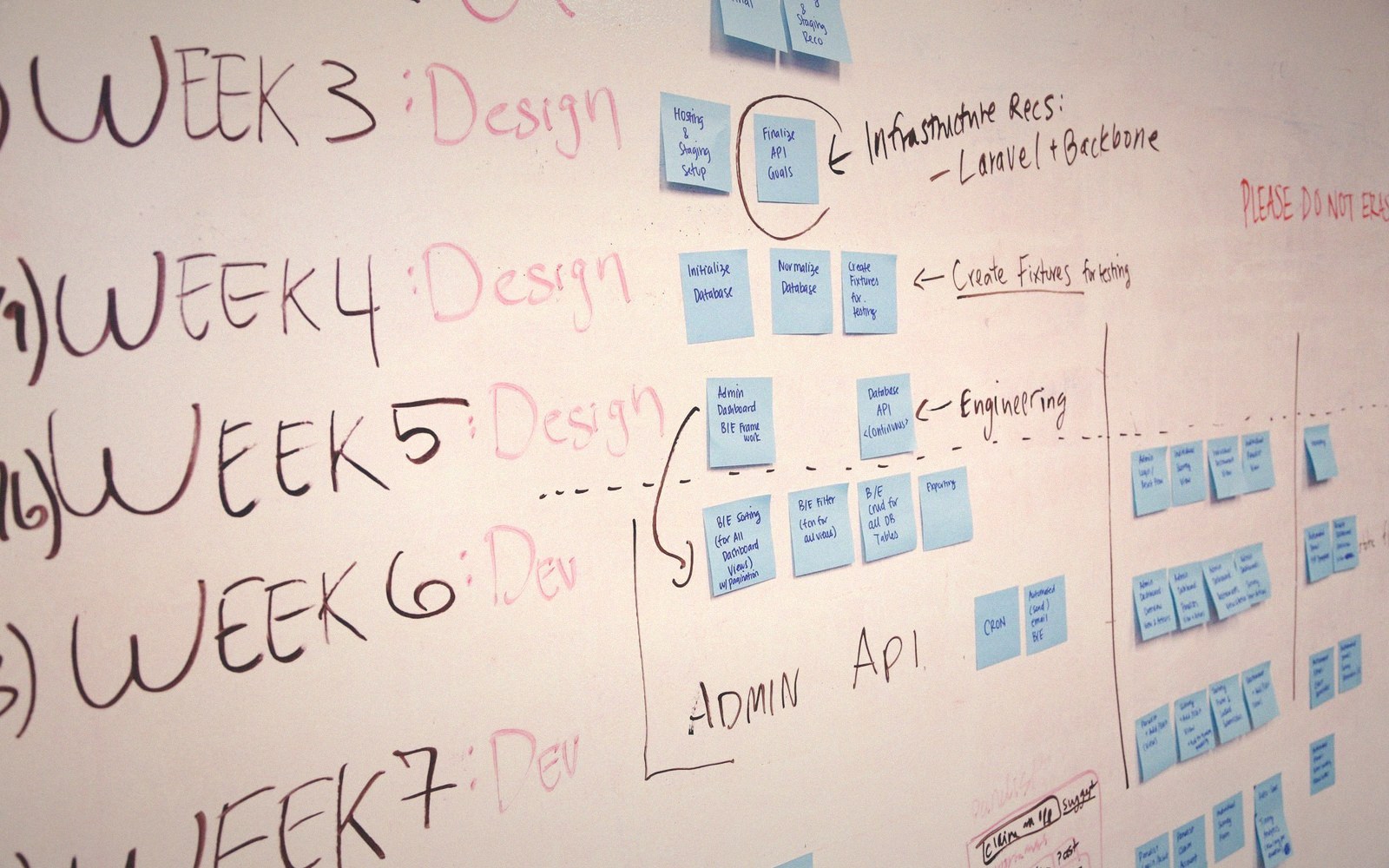
Planning furniture: useful for sequencing work, useless for predicting the last ten per cent.
Photo: Startup Stock Photos / Pexels
How to use it honestly
The slice should be understood as a proof of concept and a learning instrument, not a production-rate benchmark. Its real outputs are: a resolved visual target that the art team can hold themselves to, a set of solved technical problems that should be documented before everyone moves on, and a realistic sense of the gap between the game as imagined and the game as built.
Used well, it also forces scope discipline early. A team that cannot finish one level to shipping quality in pre-production does not have a scope problem yet — it has a foundation problem. The slice is where that becomes undeniable, when there is still time to act on it.
Treat the slice as gospel and you will misread your own schedule. Treat it as a controlled experiment with documented results, and it earns its place as one of the more useful things a production can do before full development commits.